Category Archives: Listening

Blueberries for Breakfast-July 11, 2021

Wild Blueberries next to our house.

Yesterday marked a year since my husband was diagnosed with a brain tumor, one of the not good kind. I think that I’ve written here a few times since then, I believe, reflecting on some of the changes that have happened. The year and-a-half of the pandemic was marked by loss for us, as it has been for so many, with deaths of friends and family, some expected, some not, some from long-standing illness, one from Covid. The brain tumor was one more surprise of this year. I’ve been using Caring Bridge, mostly, to update friends and family of what’s happening every month regarding his treatment and state of being. So far, he does well.

I’m finding my way every day with whatever presents itself. We are living so close to the minutiae of daily life, in part, because attending to the care of someone living with a brain tumor requires that–attention to the minutiae: what will be the challenge of the day, how is the fatigue, is there enough protein in the house, can we go for a walk, or what music will wake up the brain, what healing things can we do. It’s not that we speak of these out loud every day, though some days we do. The many considerations are under the surface all the time. Every day, there are things and events that move us to tears, whether it’s in the immediacy of our personal life–like a grandchild’s sudden smile–or in the public sphere, the ongoing pandemic, the threats to democracy, the suffering of so many people and creatures, the losses of habitats, the droughts, fires, floods, storms. But next to that, next to those tears, is beauty–so jarring to live with both, the suffering and the beauty, every day, and to learn each day to expand the edges of compassion, to keep my seat and bear witness, to act, if I can, in ways of weaving justice, which is very limited right now, and to keep loving.

I went from a very public life as a pastor and community religious leader to a very hidden life. There’s relief and loss in that. Relief for being able to put down some responsibilities, and loss for being able to put down some of those same responsibilities. I miss my public life and our lively community, and I cherish this new very familial and private one.

In this hidden life, courage and perseverance have become the loving virtues that shine most brightly to me, mostly my spouse’s immense courage and devotion to living the fullness of existence. And in the wider world, the courage and perseverance of so many people working to create a better world, who never give up the work of hope and justice. On the small scale, our home scale, the virtues are the same. Why do I rise in this morning? How will I live this day, how will I love, how will I serve?

Today in our hidden life, my beloved went out early in the dawn to pick wild blueberries. It’s a beautiful morning, very mild, post tropical storm Elsa. Picking blueberries is not an easy thing for him. His balance is uncertain on uneven ground, so he has to find a way to set his feet on the granite and moss without feeling like he might fall over. His right hand hand isn’t working very well, from the tumor, so sorting through leaves and picking the berries off takes great concentration. “I dropped quite a few” he reports when he comes in, “good for the birds.” While he was picking, the catbirds talked from the birch tree, and a chickadee dropped into the bushes to feed on the berries, just a foot away from his gentle hands.

Later, we made oatmeal, and ate the berries. I haven’t presided at a communion service since March 15, 2020, when we closed our building. And in October, I left my call to be able to be here at home. But these blueberries, this oatmeal, this beautiful morning, these loving hands that picked the blueberries, the birds in the birch trees, the wet ground, the drift of cloud, my spouse lifting his spoon carefully, this moment, this, too, a communion.

Advent Halfway or So

chagall mary

The readings in Advent always take me to a place that theologians call the “margins.” Between Isaiah’s prophecies and John the Baptist, I get caught up in the fullness of their vision of the Reign of God, the richness of their dreams, the urgency of their prayer. Advent calls us to draw near God, even as the prophets announce that God is already drawing near to us. The Reign of God, John the Baptist cries, draws near in Christ. The yearning for God expressed in Advent, can take us to the margins of our lives, as it took Jesus.

During my sabbatical this year, I spent three months traveling around the country, visiting intentional communities that seemed to me to exemplify the biblical vision of Beloved Community, groups of people whose souls have caught the prophetic vision of the Reign of God, and are striving to live it in community–this is what church is, of course, but these folks were also forming intentional communities to express that vision in their every day lives, sharing homes, resources and a mission to their neighborhoods.

Beloved Community is a term that became popular during the Civil Rights era in the United States, but its history is older, and its modern expression goes back to the turn of the 20th century. Beloved Community is the language for an ideal—or a vision, a metaphor for the reign of God, or the kingdom of heaven—in religious terms, a horizon toward which we move, also a biblical vision, articulated in scripture. The biblical prophets point us in the direction of Beloved Community; Jesus’ teachings do as well, based as they are in prophetic faith, teachings that break into history with transforming love, working within individuals and in communities. Beloved Community can be thought of in a variety of ways: a community of repentance, a community of memory, a community of hope, grace, revelation, love and justice. The modern use of the phrase is attributed to philosopher Josiah Royce, who founded the Fellowship of Reconciliation. In 1913, Royce wrote, ‘“My life means nothing, either theoretically or practically, unless I am a member of a community.” Beyond the actual communities that we directly encounter in life there is the ideal “Beloved Community” of all those who would be fully dedicated to the cause of loyalty, truth and reality itself.'( See: https://plato.stanford.edu/entries/royce/). Later the Rev. Dr. Martin Luther King, Jr. would adopt this language of Beloved Community, and popularize it in his sermons and speeches, as something that was achievable, rather than a far off horizon of vision. It was a realistic goal: “In the Beloved Community, poverty, hunger and homelessness will not be tolerated because international standards of human decency will not allow. Racism and all forms of discrimination, bigotry and prejudice will be replaced by an all-inclusive spirit of sisterhood and brotherhood.” For King, the method to achieve this goal was creating a critical mass of people trained in the theory and practice of non-violence. “Love and trust will triumph over fear and hatred.” (From The King Center: http://www.thekingcenter.org/king-philosophy#sub4)

The Beloved Communities I visited were all informed by the powerful stream of  imagery, theory, teachings, and practice about what it means to create just and loving communities, exemplified in the biblical prophets and in Jesus’ teachings, in Dr. King’s work, and those who came after him. Most were Christian or interfaith communities, and all of them lived close in with people who have been, or may be still on the “margins” of our society. Now, here’s what this has to do with Advent: Jesus lived on the margins–this isn’t a new thought in Christian theology; it’s a foundational understanding of Jesus’ identity. From his birth in a rural village in the out-post of the Roman Empire, to his death on the cross, Jesus makes his home with the “anawim,” the Poor Ones. (See Raymond Brown: The Birth of the Messiah).

This year, because of our divisive politics, and some of the cruel measures being taken against the people Jesus calls us expressly to love, I find myself feeling an even deeper urgency to understand, help, and advocate for those who are being pushed to the margins of security because of poverty, immigration, discrimination of any kind, racism, sexism, classism, disabilities, mental illness, addiction.  Anger and prayers about injustice are not enough; faith is active in love. Jesus lives there, in the lives of people who are struggling for justice, truth, and love. Advent can take us into the blessing of those struggles, if we are not there already.

Here is an example. I call it the first principle of the discipline of loving the neighbor: get to know them. In one of the communities I visited, the members simply took regular walks in their neighborhoods, making it a point of learning about the lives, needs, and struggles of everyone who was within walking distance of their communities and churches. What they found, and what we will find, should we do it, are the intersections of our lives. Everyone needs safety from violence. Everyone needs food. Everyone needs shelter. Everyone needs health care. Everyone needs dignity and respect. Everyone needs decent work. Everyone needs love. As they got to know who their nearer neighbors actually were, it expanded their sense of belonging and opened their hearts to generosity and curiosity about their differences and their shared experiences. They discovered, as we may discover, common struggles, our interdependencies, our interconnections.  Refugees live nearby; homeless shelters are down the street; food pantries and soup kitchens feed the person next-door–we ourselves may need those same soup kitchens, too; local libraries offer help with ESL classes, and filling out government documents and forms; neighborhood houses of worship host health clinics and homeless families in transition. Soon the word “stranger” became and becomes the word “friend.”

Charles Marsh writes in his book on Beloved Community, “We must learn how to perceive the living God who is building a new world in unexpected places and shapes; indeed, we must learn what it means to enter the new world of God. In short, we must relearn the meaning of being a Christian. For if Jesus Christ is Lord of the church and over all creation, power, and principalities, as Christians believe, then our first order of business must be to learn again how to participate in the gift…But let us not for a moment conceal from ourselves the fact that obedience to this vision–our actual acceptance of what the Bible proposes: “Come to me all you who are weary and burdened, and I will give you rest”–is a step into space, “an undertaking of unknown consequences, a venture into eternity.” Christian discipleship leads one into the most passionate worldliness and the experience of life’s polyphony, its beauty, anguish and complexity…in church we are taken up, perhaps even against our will, into a fellowship of astonishing variety and difference. In church, we are taken into “Christ-time” …and given the hope that our fragile and infrequent experiences of reconciliation will one day become an eternal feast” (p. 214-215). May this Advent take us to the margins, out past our comfort, and gather us up into that astonishing world of “Christ-time” and “Christ-love”, toward the unexpected and mysterious down-to-earth ways that the love of God might be born anew in us and in our beloved communities.

Morning prayers

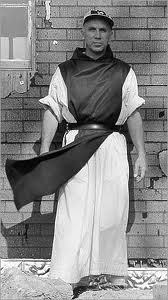
Merton

Thomas Merton produced a beautiful collection of the sayings of the Desert Fathers. There were Desert Mothers, too, but this morning, I had been thinking about Merton specifically. He’s been on my mind of late because he’s been in the news again, thanks to Pope Francis’ reference to Merton in his recent remarks to our US Congress.  The photo above has been taped the wall of my study for the last year. I’m using it as a way into an icon of St. Ansgar–an icon I’m writing at a snail’s pace. Merton is there because, like Ansgar, his monastic life grew from Benedictine soil. I had also endlessly researched what monks might have worn in the 9th century–and in the end, gave up, and went for anachronism, using a version of robes derived from a statue of St. Ansgar in Copenhagen, and the habit in this photograph of Merton.  Ansgar, far from being enclosed, was a missionary monk, eventually becoming an archbishop, and as much as he sought asceticism, and even martyrdom, he was drawn into the life of the world by his gifts. Thomas Merton was, too, and I’ve always loved the tension in his writings and journals, between the man who sought silence, and the man who must write. Merton was one of the people who drew me into a professional religious life, partly because of his complexities, mostly because of his journals, where so much vivid experience and observation are integrated through the writing. In his book on the Desert Fathers, called The Wisdom of the Desert, one saying has stayed with me for the many times I have felt overwhelmed or don’t have any idea of what to do next. I thought of it this morning, because of Merton, and because of the beautiful quiet of the dawn, today; it became a prayer. It’s short: “Abbot Pastor said, ‘Any trial whatever that comes to you can be conquered by silence.'” I don’t know if that’s true. But I come back to it, many times. I’ve really found it useful in ministry–the art of keeping quiet, very illuminating and freeing. Merton said, somewhere, in one of his journals, that the silence of prayer was where he heard the cries of those who suffer most clearly. That, I know, is true, for me. And there’s another silence, too, that heals, and opens into peace and hope. That’s the silence I will seek today.

Pondering the mountain

climbing the mountain

Yesterday, I had the good fortune to spend time at a monastery in Connecticut. It was a retreat for a church council who have a kind of mountain in front of them. Like many churches in New England they struggle with issues involving older buildings, shrinking towns, less young people, the stony nature of mission fields in our region. But something extraordinary happened in our time together. We told stories of times our needs were met in our faith community. They became stories of times we were met by God in community, in worship, in service. In the simple act of listening, and then sharing what we heard, the mountain became something less fearful, something more inviting, something to be curious about. And possibly something, also, that we could actually climb, even the freedom to decide, maybe we don’t want to climb this particular mountain.

What struck me was the longing in the group to spend more time in prayer and quiet, to focus on worship, and let go of the busy-ness they were feeling, spiritual hunger for time with God. By the end of the session, we were talking about what we could let go of, so that we would be freer to spend time listening to God, to each other, and to have more sabbath time. In terms of climbing mountains, it was a moment where we put down our packs, and took out the things that we didn’t need.

I spent some time this summer in the mountains, myself, on both sides of the country: the White Mountains, and the upper end of the Appalachians in Maine, driving through them, alas, not hiking; and also in California along the coastal ranges. I was astonished at how many ways human beings and animals had found to make paths up them and through them, often following river beds, but sometimes you could tell the path was made by sheer doggedness. One morning, on the top of a ridge, in California, I counted at least six different footpaths, all leading up and over, traversing ravines, hummocks, knots of woods. The same was true in the mountains here at home, many trails, many possibilities, easier climbs, harder climbs, climbs along rivers, climbs across rock faces.

The mountain is still a mountain. There are many ways through.