Category Archives: Pondering

Blueberries for Breakfast-July 11, 2021

Wild Blueberries next to our house.

Yesterday marked a year since my husband was diagnosed with a brain tumor, one of the not good kind. I think that I’ve written here a few times since then, I believe, reflecting on some of the changes that have happened. The year and-a-half of the pandemic was marked by loss for us, as it has been for so many, with deaths of friends and family, some expected, some not, some from long-standing illness, one from Covid. The brain tumor was one more surprise of this year. I’ve been using Caring Bridge, mostly, to update friends and family of what’s happening every month regarding his treatment and state of being. So far, he does well.

I’m finding my way every day with whatever presents itself. We are living so close to the minutiae of daily life, in part, because attending to the care of someone living with a brain tumor requires that–attention to the minutiae: what will be the challenge of the day, how is the fatigue, is there enough protein in the house, can we go for a walk, or what music will wake up the brain, what healing things can we do. It’s not that we speak of these out loud every day, though some days we do. The many considerations are under the surface all the time. Every day, there are things and events that move us to tears, whether it’s in the immediacy of our personal life–like a grandchild’s sudden smile–or in the public sphere, the ongoing pandemic, the threats to democracy, the suffering of so many people and creatures, the losses of habitats, the droughts, fires, floods, storms. But next to that, next to those tears, is beauty–so jarring to live with both, the suffering and the beauty, every day, and to learn each day to expand the edges of compassion, to keep my seat and bear witness, to act, if I can, in ways of weaving justice, which is very limited right now, and to keep loving.

I went from a very public life as a pastor and community religious leader to a very hidden life. There’s relief and loss in that. Relief for being able to put down some responsibilities, and loss for being able to put down some of those same responsibilities. I miss my public life and our lively community, and I cherish this new very familial and private one.

In this hidden life, courage and perseverance have become the loving virtues that shine most brightly to me, mostly my spouse’s immense courage and devotion to living the fullness of existence. And in the wider world, the courage and perseverance of so many people working to create a better world, who never give up the work of hope and justice. On the small scale, our home scale, the virtues are the same. Why do I rise in this morning? How will I live this day, how will I love, how will I serve?

Today in our hidden life, my beloved went out early in the dawn to pick wild blueberries. It’s a beautiful morning, very mild, post tropical storm Elsa. Picking blueberries is not an easy thing for him. His balance is uncertain on uneven ground, so he has to find a way to set his feet on the granite and moss without feeling like he might fall over. His right hand hand isn’t working very well, from the tumor, so sorting through leaves and picking the berries off takes great concentration. “I dropped quite a few” he reports when he comes in, “good for the birds.” While he was picking, the catbirds talked from the birch tree, and a chickadee dropped into the bushes to feed on the berries, just a foot away from his gentle hands.

Later, we made oatmeal, and ate the berries. I haven’t presided at a communion service since March 15, 2020, when we closed our building. And in October, I left my call to be able to be here at home. But these blueberries, this oatmeal, this beautiful morning, these loving hands that picked the blueberries, the birds in the birch trees, the wet ground, the drift of cloud, my spouse lifting his spoon carefully, this moment, this, too, a communion.
Advent Week 1 2020

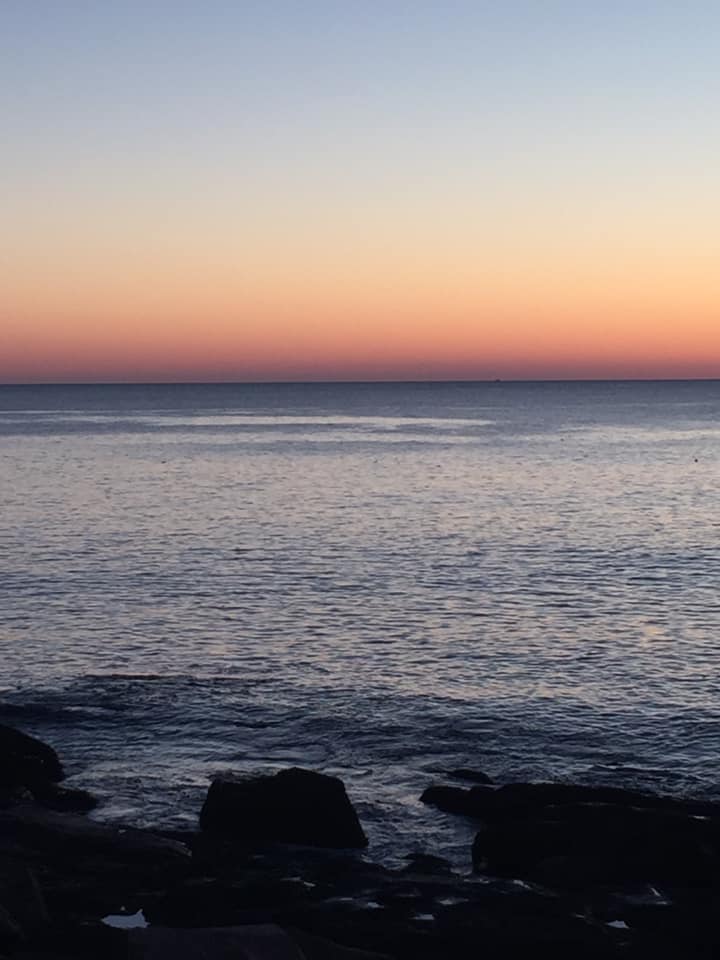
I woke up very early on November 29th with a pressing need to watch the sunrise down the road. We live near a road called Eden, which seems appropriate given the spectacular view of the ocean at the edge of the rocks. Where the water meets the granite, there are endings and beginnings, much like this season of Advent, which begins with Jesus preaching of endtimes, and Isaiah calls on God to rend the heavens and come down. I could do with less apocalypse this year, since we’ve already had so much of it, but it’s an ever-present reality, apocalyptic possibilities–I don’t need to name them; just turn on the news.

A confession: this week, I’ve felt the profound loss of no longer working in a parish. I am homesick for church, like everyone else in the pandemic. I miss every bit of the Advent preparations: the going up to the attic to look for the candles, scrabbling in the sacristy, finding greens for the wreaths, do we have enough candles, where are the stars, everything we usually do, which we’d be doing if not for a pandemic. But even in the pandemic, I miss the tasks and preparation, the pondering of scriptures, the thinking, the conversations, the wondering what good word do people need to hear this year, what good word do I need to hear, the wondering how to do another on-line service with integrity and care, and the frustration of feeling so much without being able to see people in person. And now, there’s a further distance in leaving my congregation, for this strange pause I’m calling retirement, but which is really a time out to be with my husband. One of the secrets of parish ministry they don’t tell you in seminary: they don’t prepare you for how much you end up loving your congregation, your people, your flock, your lambs. Because that really happens–it’s a gift, too, from God, because it’s a kind of huge love, this love of the church, not just for one’s own congregation, but a great love of the church universal, the people of God, the body of Christ embodied everywhere, in every place and time. I have no words for it, just love. And it isn’t a personal love; that is, I couldn’t come up with it on my own–it’s a grace, “unexpected and mysterious” as Jan Lindholm says in her hymn (ELW 258). And I suppose the reason I needed to see the dawn this first Sunday in Advent is I need to see the promise of this season, the hope of this season, and remember, and embody, in my life now, with it’s changed orientation, this wild love of God’s people, whether I am serving a congregation, or bearing witness to my spouse as he meets the demands of living with brain cancer, or praying by the ocean on a cold morning in November.

Christmastide/Jesus’ Baptism

On the eve of the baptism of Jesus, I happened to discover a poem of Denise Levertov’s called On the Mystery of the Incarnation. The first lines struck me, because I feel like I’m living in a time when I see our species doing its utmost to destroy our planet. I was trying to find a way to preach about Jesus’ baptism, and also acknowledge the current suffering of our world, not just our species, but all species, the earth itself, between massive fires in Australia, earthquakes in Puerto Rico, floods, storms, war, threats of war. Levertov’s poem opened like a pause in a litany, a breath, a rest, an epiphany all its own, a bit of light in the darkness. I’m grateful for that.

Denise Levertov (1923–1997)

On the Mystery of the Incarnation

It’s when we face for a moment
the worst our kind can do, and shudder to know
the taint in our own selves, that awe
cracks the mind’s shell and enters the heart:
not to a flower, not to a dolphin,
to no innocent form
but to this creature vainly sure
it and no other is god-like, God
(out of compassion for our ugly
failure to evolve) entrusts,
as guest, as brother,
the Word.

baptismalwaters

Mary and Viriditas

IMG_7596

Last year in March, we traveled to the Brooklyn Museum in search of this painting. It is called The Virgin, by Joseph Stella, (American, born in Italy, 1877-1946), and it was part of the museum’s exhibition on “Infinite Blue.” Briefly,

“The works of art in Infinite Blue feature blue in all its variety—a fascinating strand of visual poetry running from ancient times to the present day. In cultures dating back thousands of years, blue—the color of the skies—has often been associated with the spiritual but also signifies power, status, and beauty. The spiritual and material aspects of blue combine to tell us stories about global history, cultural values, technological innovation, and international commerce.” From the Museum website.

I went to Infinite Blue because wanted to see this depiction of Mary, one of the most captivating images of her I have ever seen. I first came across it a few years ago when I was searching for icons related to Hildegard of Bingen, and like Elizabeth in the Gospel of John, my heart leapt when I encountered her. I’m guessing that this particular Mary appeared in the gallery of images because of the abundance of growing things, surrounding, entwining, embracing her, the figures of flowers and vines embroidered on her clothing, the circle of blossoms where Jesus will be…Hildegard’s “viriditas” “greening” is everywhere in this painting. I haven’t looked at the history of this work, so I have no idea if Joseph Stella intended the “viriditas” connection. But what this icon has done is change my experience of Mary. She is always a source of life, carrying the divine within her. She is a garden, here, of earthly and heavenly delights, of beauty and wilderness, of fecundity and blossoming. This is imagery I usually associate with the incarnation and the Tree of Life. There’s no reason Mary shouldn’t be a part of that. I had just not seen it in quite this way. Here, Mary herself becomes a tree of life, which I suppose every woman is: not a Mother Earth, which is always the temptation with Mary, or a representation of the goddess, but a woman who bears and brings and carries life. Stella depicts her as serene, peaceful, but also, I think as holy possibility, that moment after or before or in the midst of her “yes.”  This Mary is born of the beauty of earth, and the divine manifests in and through the beauty of earth, the necessity of the material. Like all icons, Stella’s Virgin is a window into a perception of the holy, here entwined in, and arising from, the lavish blessing of creation.  I wish I could thank Joseph Stella in person. But perhaps he knows already.

Big Sur in May

image

The trees in this picture may be burned now. I saw them in May on an epic drive down Rt. 1 from Carmel to Cambria, California. They are in the Julia Pfeiffer Burns State Park. We were visiting family there. California became home to my daughter some years ago. She was born there, but didn’t return until her early 20’s. She’s forty now, and I’ve been visiting the state regularly, a few times a year. We loved California when we lived there, and we love it still.  California has suffered drought now, for over five years, and this year’s summer fires testify to a tinderbox landscape.  The last time I drove up Rt. 101 to the airport, in spring, firefighters and trucks were busy along the edges of the road, putting out small blazes that started between the highway and the farm fields; sparks become flames quickly in such a landscape. My daughter spent some time in Israel several years ago, and came home convinced that the next big economic, political and social struggles would be about water rights. She has certainly experienced that in California, in her town, and around the state, as access to water has become critical, and hotly debated. During the recent fires, she called to tell me things were getting “apocalyptic.”Now toward the end of September, news of forest fires, floods, vast storms, violent shootings, home-made bombs in cities, military bombings, racism and bigotry, vitriolic presidential politics, divisive and abusive public rhetoric, here and around the world, appear almost non-stop on radio and television stations, in papers, magazines, and social media, permeating everyday conversation, and I agree, it’s feeling apocalyptic.

When we drove through Big Sur, fogs rolled up the cliffs, and drifted in and through the trees. The sun was shining up above, and the light filtered through the woods, shimmering on drifting wisps of cloud, the whole atmosphere cool, and slightly damp, despite the drought. It’s no surprise that cathedral pillars resemble trees–and vaulted ceilings resemble vaulted forests. We remember them in our bones; groves of trees are holy places. In the woods that day, there was still water running in one of the brooks, the sound gurgling down through rocks. When we entered the redwood forest there, all the sounds except for birds and the nearby stream, grew quieter. We grew quieter, the further in we walked. The forest had been burned before, some years ago, and we noticed right away some of the charred markings from long ago fires. We sat for some hours under the trees, marveling at their height, and their ancient impassive presence. But most of all we marveled at their resilience.  Earlier this month, as I read and listened to the news of those fires through the forest in Big Sur, I wondered about the trees which had sheltered us that day. I sometimes feel their roots in me, in my body, that some part of me is as old and present as they were.  I reach out to them through my body and mind, looking for them,  wanting to shelter them in return. Consider the lilies, Jesus said.That phrase has become a symbol for the contemplation of all things living, for all creation. Consider the redwoods, the trickling water, consider the Pacific waves, and the mountains falling into the sea. Consider, even the fires that burn the forests, the interconnections of all our lives and the sorrows of the world. Consider the earth crying out, consider the voices of birds, the haunting call of a loon in the North Woods, consider the whispers and echos of now extinct species.

I checked on the fires yesterday, those still burning,  new ones starting. May the rains come soon.


Diversifying the ELCA: An Alternative Proposal

A forward-looking, encouraging blog from Bishop Michael Rinehart of the ELCA, on possibilities for meta-ecumenical local partnerships in ministry. Worth a read.

Gulf Coast Synod's avatarConnections

By Bishop Michael Rinehart

Church service

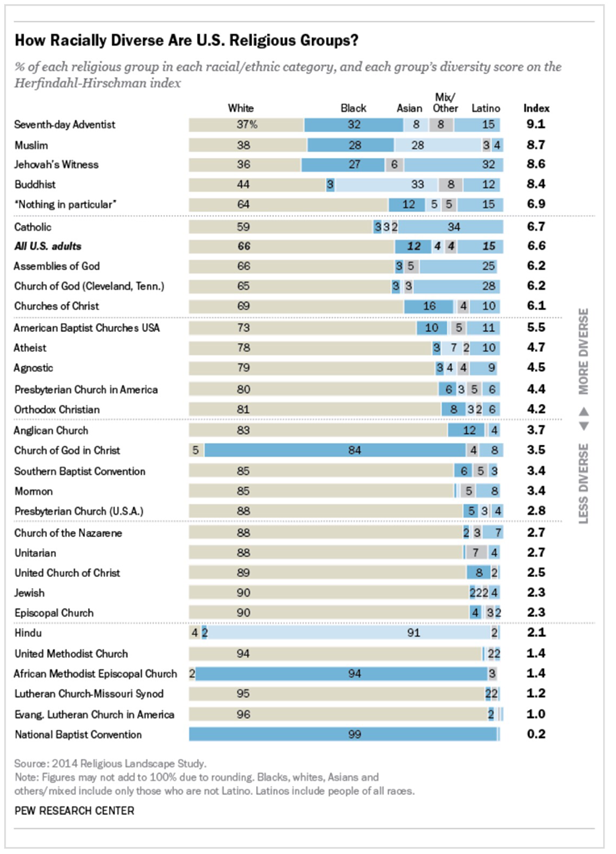
Our goal was to be 10% persons of color in the Evangelical Lutheran Church in America (ELCA) by 1998. In 2016, we are still 96% white. In this synod we are 92% white – better but not good for a synod which includes Houston, which is 50% Latino, and New Orleans, which is 50% African American.

racially diverse religious groups

In our neck of the woods, the Anglo population is actually in decline. The Latino population is swelling, as well as the Asian population. Under the age of 25, 70% of Houston is Latino. Do the math. Just from the vantage point of enlightened self-interest, the Lutheran Church must look at this. There are, however, much more important reasons.

Asians, African Americans, Latinos, Anglos et al have a different angle of vision, based on their life circumstances and location in society. Those more likely to be living in poverty, less…

View original post 1,449 more words

Passed the Solstice

When I began to write this, it was the first morning of the first day of winter, and with it the return of the light. Dawn was heavy here, deep gray clouds over a deep gray sea. But it’s two days until Christmas, now, rainy, foggy, wet, and the dark is long. Despite the heavy gray, with the shift into winter, I know that light will come back soon. I reread several times, the words to a Christmas carol: “Lo, how a rose.” In all the frenzied rhetoric of politics, and the inflated hysteria of news coverage, I’m so glad to be reminded of the quietness of Advent, and the waiting, the image of a rose not yet bloomed.

Tuesday was the shortest day–the fewest hours of actual sunlight. Today was not much different, this Wednesday before Christmas. The North Pole is tilted away from the sun, tipped earth, ready to turn back, like that far pose of a dancer who leans into space until we think she might fall, and then, as gracefully returns again. The earth rounds her courses along the horizon, the changing line of the sun’s rising mark the course. “O Dawn,” rings in one of the O Anthiphons. And here, for encouragement, from the Rule of Taize: “Renouncing henceforth all thoughts of looking back, and joyful with infinite gratitude, never fear to precede the dawn: to praise and bless and sing Christ your Lord.”

Never fear to precede the dawn with praise. Tonight is a waiting night. Everything is almost ready, a few last details. Each moment I’m grateful for the peace with which I live these days, and carry inside me, too, the sorrows of people, of friends, of family members, of parishioners, of strangers wandering far from home, of what seems like an endless cycle of violence, and into all that a child is born. We had a real baby this year for the Christmas pageant at church, and all he wanted to do was hold onto one of the children’s hands. You could see his tiny fingers grasping hers, curled around, and holding on for dear life. She held onto him, and he held her, an image of Christmas, holding God holding us.