Category Archives: Prayers

The Blueberries Are Not Yet Ripe

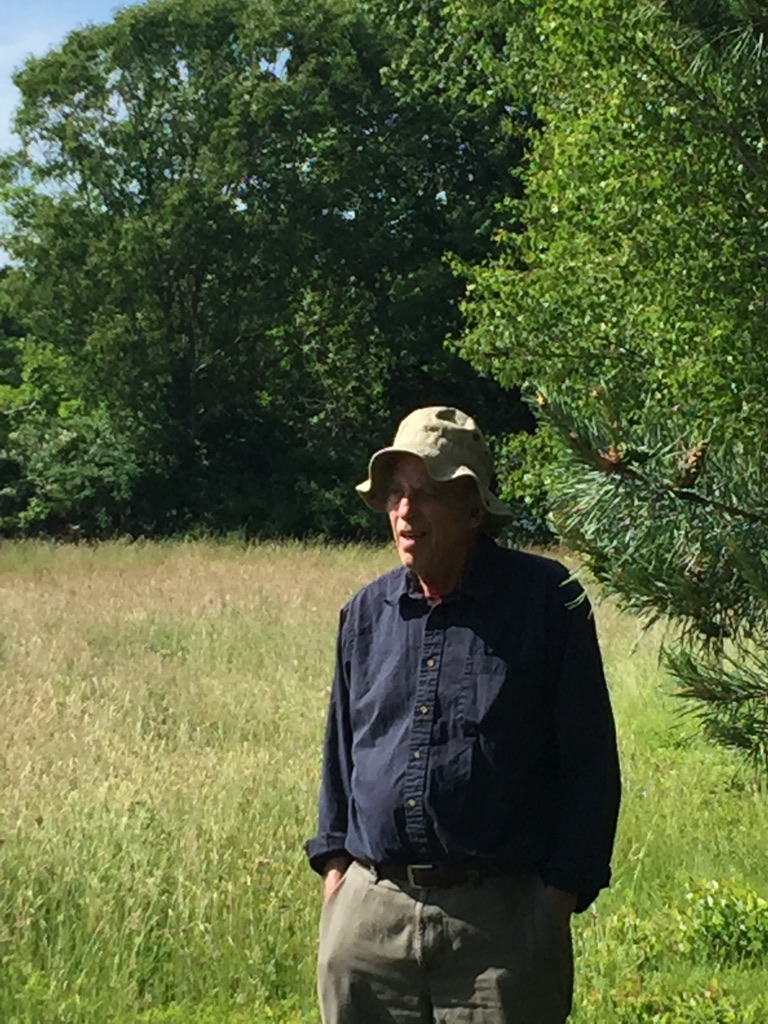
Beautiful Willy last summer in the field out back.

It’s mid-June, and the blueberry bushes have flowered, petals fallen, and tiny green berries have begun to take shape. These will ripen about mid-July, but my beautiful husband Willy is not here to pick them, to celebrate them, to put them on his oatmeal and enjoy their tart “wake-up” taste on his tongue. He died four days into Passover, on April 19th, two days after Easter. There was a rainstorm that morning, and startling thunder. Later that afternoon, our Rabbi told me it is said that it always rains when a zaddik dies.

On Sunday it will be two months since his death. I hardly know how to write any more. I had kept up with our Caring Bridge entries, even writing a final one a few days afterwards, but I’ve not written much since then. I’m writing this because I’m stunned by how little I understood the grief of spouses whose beloved has died. I’d been a pastor long enough and accompanied enough people in mourning to know the loss of a partner/spouse is devastating, to know there is nothing else like it, to know how it rips the psyche and the body apart. Even a peaceful death, as his was, is still a death–and heart-rending is not too strong a word. Even if it was expected, as his was, there was nothing that could have prepared me for what would happen afterwards. I had no idea I could hurt so much and still be breathing. If I ever go back to serving a congregation, I will have so much more awareness of the effort it takes a surviving spouse to keep going, and I will take so much more care. I am so sorry I did not realize the depth of that invisible pain.

Mornings and evenings are the hardest time for me, at least: transitions of night into day, and day into night, those edgy times not quite light, not quite dark. When I wake up, I reach for his pillows. I haven’t washed them because they still retain a faint fragrant memory of him. He loved the dawn, the sunrise, and we both used to wake up early for the morning. Now when I wake, I try to remember to do what he did–to greet the light with a blessing–Baruch HaShem. Remembering how he lived each day, because he cherished life, has ended up being the greatest comfort. I get dressed because he would have wanted me to. Lately, mostly to honor his memory, I’ve been eating breakfast on our screen porch, listening to birds, wandering out to the garden to see how things are growing. He did that in the mornings in summer. I bring him with me, trusting that he’s using my eyes. At night, like many bereaved spouses, I have trouble falling asleep. For the first few weeks, I slept downstairs on the couch in front of the TV, watching endless replays of the Bridgerton series on Netflix. They were love stories with happy endings, but they are not the sort of shows Willy would have watched. I apologize to him for watching them now, but I mostly fall asleep in front of them. Eventually, the cats wake me up to go upstairs; they don’t like late night TV. The bed is daunting–so empty of him.

On the day after he died, visitors came to sit with me. On that first day, 15 people came, 11 of whom had lost their spouses. As my niece, who also lost her spouse, put it: they knew to come. In the weeks since his death, my friends who know this landscape of loss have shared their wisdom with me, much of which boils down to having patience with whatever is happening, being gentle with myself, taking care of myself, not expecting much of myself, and one-day-at-a-timing it. It helps to know that they’ve lived through this. And just their presence is a comfort. His good friends come and don’t mind my talking about him endlessly. They want to talk, too, and that’s a relief. I have no idea how to answer the question: how are you. I rehearse answers: I’m fine. I’m terrible. I’m not ok. I’m ok. Lately, I’ve landed on this: “I have no idea how to answer that.”

Today, this mid-June day-was truly a beautiful day, as only a sunny June day on Cape Ann by the sea can be. I can’t say I was happy–but I did find something nice to wear. I did make toast and coffee. I did manage to go to the bank. I did do a laundry. This morning because it was warm and a gentle wind blew, I took the newly washed clothes outside to hang them on the line. When we got married, Willy asked me what I wanted for a wedding present. I said I wanted a clothesline. He was shocked. He was thinking jewelry. But it was true. I love hanging clothes on a clothesline, and I hadn’t had one since my children were small. For some reason, a clothesline meant home to me, and of all the things in the world I wanted to do, I wanted to make a home with him, a loving home, a kindly home. So he made me a clothesline, sunk the posts, strung the rope, in a perfect spot that catches the sun near a big fir tree. We both loved putting the clothes out. When I put them out today, I didn’t cry after all, but smiled instead into the morning light, and thanked him for the clothesline, for the home we made together, and the home that he was and is for me.
Advent Week 1 2020

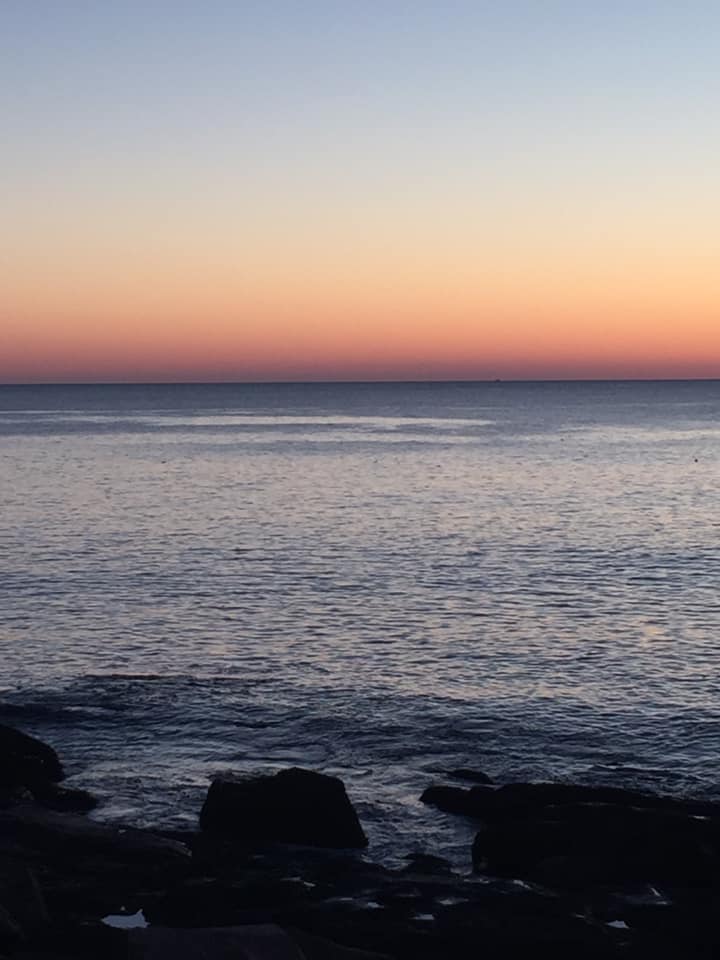
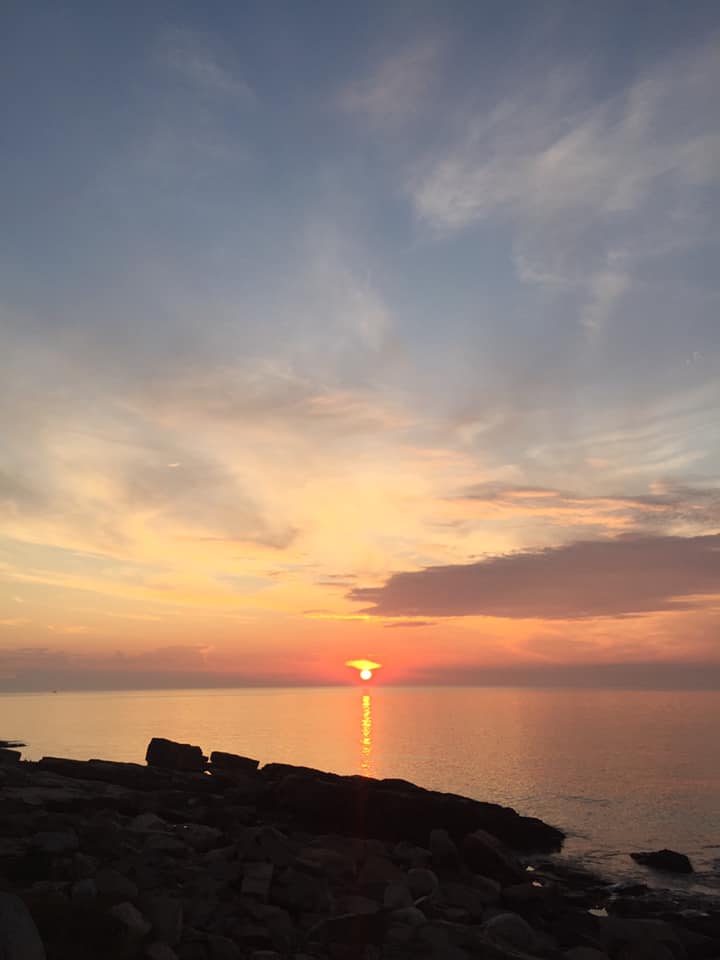
I woke up very early on November 29th with a pressing need to watch the sunrise down the road. We live near a road called Eden, which seems appropriate given the spectacular view of the ocean at the edge of the rocks. Where the water meets the granite, there are endings and beginnings, much like this season of Advent, which begins with Jesus preaching of endtimes, and Isaiah calls on God to rend the heavens and come down. I could do with less apocalypse this year, since we’ve already had so much of it, but it’s an ever-present reality, apocalyptic possibilities–I don’t need to name them; just turn on the news.

A confession: this week, I’ve felt the profound loss of no longer working in a parish. I am homesick for church, like everyone else in the pandemic. I miss every bit of the Advent preparations: the going up to the attic to look for the candles, scrabbling in the sacristy, finding greens for the wreaths, do we have enough candles, where are the stars, everything we usually do, which we’d be doing if not for a pandemic. But even in the pandemic, I miss the tasks and preparation, the pondering of scriptures, the thinking, the conversations, the wondering what good word do people need to hear this year, what good word do I need to hear, the wondering how to do another on-line service with integrity and care, and the frustration of feeling so much without being able to see people in person. And now, there’s a further distance in leaving my congregation, for this strange pause I’m calling retirement, but which is really a time out to be with my husband. One of the secrets of parish ministry they don’t tell you in seminary: they don’t prepare you for how much you end up loving your congregation, your people, your flock, your lambs. Because that really happens–it’s a gift, too, from God, because it’s a kind of huge love, this love of the church, not just for one’s own congregation, but a great love of the church universal, the people of God, the body of Christ embodied everywhere, in every place and time. I have no words for it, just love. And it isn’t a personal love; that is, I couldn’t come up with it on my own–it’s a grace, “unexpected and mysterious” as Jan Lindholm says in her hymn (ELW 258). And I suppose the reason I needed to see the dawn this first Sunday in Advent is I need to see the promise of this season, the hope of this season, and remember, and embody, in my life now, with it’s changed orientation, this wild love of God’s people, whether I am serving a congregation, or bearing witness to my spouse as he meets the demands of living with brain cancer, or praying by the ocean on a cold morning in November.

Nine Months Later

The last time I wrote was nine months ago, in the season of Christmastide. Not long after, in mid-February, my mother died. At 98, she had lived a full and invigorating life. She was, however, not interested in dying. Her nurse tried to get her to discuss the matter as she approached that passage. On the last day of her life, the nurse asked her whether she was prepared for what was about to happen, “Are you ready?” My mother answered simply, “no.” She became ill around this time last year, and caring for her became a focus for the autumn and winter. She was very close to her two younger brothers, our sweet and cherished uncles, one of whom had died a few years ago. At Thanksgiving time, in 2019, her second brother died. She lasted a few more months. She was an intensely political person, very concerned about the direction of the country. She was an advocate and activist for many worthy causes, affordable housing, health care, education, voter rights, women’s equal rights, Civil Rights. She worked in local politics and volunteered in national politics; she was a longtime member of The League of Women Voters. She feared for the outcome of the next election, knowing full well the dangers and reality of international interference in fair elections. We often thought, in addition to loving her family, she might have been wanting to stay alive to vote in 2020. Once she achieved the milestone of 98, we thought she might try for 100.

We had decided on a memorial of May 9th, the Saturday before Mother’s Day. Shortly after her death, the Covid19 pandemic escalated, and soon many people were working from home, practicing social isolation and distancing, and other Covid related measures. My vocation as a pastor changed dramatically, as our church learned to become an on-line congregation, an arduous learning curve for many religious leaders.

Easter and Passover came and went, then Pentecost and Shavuot. Now the High Holidays are approaching; this week, in fact, the Days of Awe begin. In mid-July, my beloved was diagnosed with a brain tumor, and our lives changed again, rapidly. About a month after his biopsy, he began chemotherapy. It became clear, again rapidly, my work life could not accommodate the needs at home. After several heart-wrenching weeks of prayer and discernment, I decided to retire earlier than I had planned. I am not comfortable with the language of retirement, so now, I might say, my vocation has shifted its focus to my primary call which is my family, and in particular, to spend time with and care for my nearest neighbor, my spouse.

Mortal illness in a family member or in oneself has a clarifying effect on what needs doing. My husband and I do not know how much time we will have together, now. We are wanting each day to matter, to be lived as fully and completely as possible. We had always wanted that, but embracing the truth that the fullness of existence is right in front of us is more important than ever. I will probably write more on this blog as time goes on. In the meantime, I am greeting each day with gratitude, even days like today, when my body hurts with unshed tears, for us, for the nearly 200,000 dead from Covid, for the losses and ongoing fires on the West Coast, for those endangered from the incoming swath of hurricanes in the Gulf, for those harmed and killed by continued and merciless racist violence, the weight of sadness from this last year in my own life. I am a teardrop. I breathe in and I breathe out. My husband is upstairs working as best he can. The room is full of morning light.

What will the new year bring? May it be a sweet one. L’Shana Tova

Christmastide/Jesus’ Baptism

On the eve of the baptism of Jesus, I happened to discover a poem of Denise Levertov’s called On the Mystery of the Incarnation. The first lines struck me, because I feel like I’m living in a time when I see our species doing its utmost to destroy our planet. I was trying to find a way to preach about Jesus’ baptism, and also acknowledge the current suffering of our world, not just our species, but all species, the earth itself, between massive fires in Australia, earthquakes in Puerto Rico, floods, storms, war, threats of war. Levertov’s poem opened like a pause in a litany, a breath, a rest, an epiphany all its own, a bit of light in the darkness. I’m grateful for that.

Denise Levertov (1923–1997)

On the Mystery of the Incarnation

It’s when we face for a moment
the worst our kind can do, and shudder to know
the taint in our own selves, that awe
cracks the mind’s shell and enters the heart:
not to a flower, not to a dolphin,
to no innocent form
but to this creature vainly sure
it and no other is god-like, God
(out of compassion for our ugly
failure to evolve) entrusts,
as guest, as brother,
the Word.

baptismalwaters

Returned from the Pilgrimage

chatauqua geese

The image above was taken this summer on our last leg of a sabbatical journey. I gave  the sabbatical a name: “Beloved Community: A Pilgrimage.” The lake is Lake Chautauqua, the Chautauqua Institution being one of the communities we visited during what was a 9500 mile pilgrimage around our country. I have only begun to put the experience into words. Recently, I gave an hour-long presentation at St. Paul Lutheran Church, where I serve, to try and report on what I discovered along the way. For this short entry, first, all the beloved communities we visited had a commitment to non-violence. Second, all that they did together was aimed toward healing, healing the world, their neighbors, the people living within their communities. Third, the visionary expectation of these communities was very simple–every loving act or word we offer the world in our daily life and work, wherever and whoever we are, those acts of love in speech and action, bear the fruit of peace. During the trip, I thought often of Jesus’ beatitude: “blessed are the peacemakers.”

Often in the evenings wherever we were, we took time to sit and review our days, recollecting in the prayerful sense of the word what we’d seen and experienced, talking softly, as we watched the sunset. Here, on the shore of Chautauqua, we were nearing the end of our journey. As we sat in the quiet, a family of geese swam slowly around the shore in the evening light. The geese stayed close together, goslings following their parents’ stately lead, defenseless on a shining lake. They knew they were safe there, from human beings, for the time being, so they didn’t flee when they saw us. I had been thinking about what is necessary for beloved community to arise. One thing is simple: one has to feel safe. And if safety isn’t present, the community needs to work toward it. Beloved community is built on trust.

Advent Day 17, 2016

Today, deep in Advent, I read the devastating news from Aleppo, a continuous tragedy that has haunted me day and night for months. I wake up with it, in my mind’s eye, and watch and listen throughout the day, so far away, and so unable to do anything to help. Here’s the link to the New York Times article about what happened today: Aleppo

I have no words for the sorrow of this, and for the horror of this violence. I’m not even sure why I’m writing about it now, other than to add my voice to the lamentations of others, to the terrible grief and frustration of watching tyrants and violence prevail. What is happening to us? To our humanity?  What will the survivors do, the civilians, the children do? What will God do? What will the world do?

These last weeks since the election in the US, and the endless stream of terrible news from Syria and other places, I’ve been turning to theologians and spiritual leaders who have lived through such times, and such violence, martyrs and sages, many from biblical scriptures, prophets and mystics, trying to find a path through, as a pastor, and more important, simply as a Christian in the United States. I’ve read Bonhoeffer, Martin Luther King, Jr., Thich Nhat Hanh, Elie Wiesel, Abraham Joshua Heschel, the Dalai Lama, Dorothy Day, Luther, Daniel Berrigan, and Mother Theresa, and a host of columns by my contemporaries,  brothers and sisters who are themselves, seeking faithful ways through. But we’re alive to think about it, and preach about it, and our neighbors in Syria are dead and dying. Where I go in these moments of wordless grief and sorrow, over and over again, is to Mary, not in an Advent pregnancy,  but standing at the foot of the cross, to the Stabat Mater, watching her son die, helpless to stop it. Or to the Pieta, Mary holding death in her lap.

This Advent is a Lent of the death of hope and freedom in many and various ways. Today, Day 17 of Advent, feels the way mid-afternoon on Good Friday does, a giving up of the spirit. We failed to save them, in Aleppo. And my heart is pierced with that. Maybe the only prayer today is from the Lord’s Prayer: “save them, deliver them, from evil.”

pieta-maryface

Mid-October 2016

red-leaves

Yesterday’s walk down the sidewalk proved to be an exercise in wonder. Everywhere we looked, our eyes feasted, on the burning beauty of autumn overflowing, the air as clear as clear water; sky and sea blue beyond blue. At the farmer’s market, the bins were cornucopias of the harvest, greens, oranges, reds of squash, beets, onions, potatoes, the last tomatoes, fresh apples.

And all the while, in my mind’s eye, next to this beauty, are juxtaposed images of devastation, from Syria, from Haiti, from North Carolina, the wake of storms, floods, and bombs. Like most people, I’ve been torn apart inside by what’s happening in our country especially during this presidential election season, by the ugliness, the degradation, by the violence, the on-going intersection of injustices of racism, sexism, poverty. On the one hand, all the hatred is out in the open;  we can see it. On the other hand, I’m terrified because the hatred is out in the open, and it seems like there’s a license to kill figuratively and literally, with guns and with words. It’s a raw time. My spiritual struggle is how to speak, and to act, with love, in such times, when the temptation every day is to sink into fear, anger and despair

And then I remember the stories of incredible faith, hope, and courage coming from Aleppo, from Haiti, from children, from the songs of whales, from the breath of the earth, and the Spirit’s sighs too deep for words.

This morning, I read a wonderful column/blog post by a fellow clergy-woman at https://revgalblogpals.org/ I’m sharing it below, because it’s a wonderful affirmation that words matter. And that we rise for another day, to speak words that create worlds–to borrow Abraham Joshua Heschel’s phrase. May our words make worlds of compassion.

Words Matter.

Lent II Sunday: Of Icons and Holy Hens

holyhen

Tomorrow, I leave for a 5-day painting retreat at Camp Calumet, in Freedom, New Hampshire. All evening, I’ve been packing up paints, brushes, boards, boots, mittens, warm coats, books and poetry, bits of cotton, random pieces of string I might need, masking tape, pencil sharpeners. The car is becoming a mobile studio and library. This trip has become an annual Lent pilgrimage, the drive north to the mountains through snow now a part of the expectation in this season.  This night before the retreat is one of the evenings of the year when I permit myself the luxury of perusing books of poetry, without feeling like I need to be doing anything else. It’s as if the retreat has already begun. Who will come along? Which poet this year? I find Gary Snyder’s This Present Moment; the cover depicts a snowy landscape, and just because of this, it goes in the bag–Tom Killion is the artist who designed the cover, a long-time friend and collaborator of Snyder’s. I’m quietly thrilled I will have several days to savor these poems. Sometimes a poet’s voice becomes the voice that interprets one’s life–I’ve been reading Snyder for 40 years, and he’s as present in my mind’s ear as the present moment itself.  He’s been a meditation teacher for me, just in the way of his writing.

But by tomorrow afternoon, painting will become the order of the day, this week. We will be working on an icon of St. Francis. It seems appropriate given this morning’s Gospel, to be preparing and praying about Francis this Lent, his conversations with birds and beasts, trees, water, sun, moon and stars.  I love the image of Jesus hovering over Jerusalem like a mother hen, or mother bird, calling his brood to him, gathering them under his wings (or in this case of mixed imagery, Jesus as a “her” gathering the chicks under her wings).  Francis shared that yearning. Tonight, there is a pause in the evening’s packing, a time for gathering all the parts of oneself, as a hen might gather her chicks, up into an inner shelter, a breathing in of anticipated peace, the quiet room, the laundry finishing up, everyone else already asleep.  Lent is just such a pause in a long life really, at least tonight has that feel–the pause of Holy Saturday, though it is weeks away, the pause of a mother bird, as she settles on her nest, the pause between breaths, the pause between death and life.

Epiphany 1 day out

follycoveinkspots

This afternoon, I had an unexpected pause in the day, around 3:00 p.m. I was able to stop for awhile, and park near a famous cove on Cape Ann, Folly Cove.  The name came from a failed experiment of harvesting salt, or so I hear.  I thought it was named for the the “folly” structure overlooking the Cove from one of the ledges nearby, an octagonal building, in gazebo style, or perhaps a Japanese style–hard to tell at a distance, looking across the water.

It’s a quiet afternoon; very little traffic on the road next to the Cove. A few parents drive by, to wait up the street at the bus stop for their children. I think someone recognizes my car, and honks.  After several minutes, I lose awareness of the time, though the waves of the water keep pace with heartbeats.  A small flock of buffleheads, black and white males, brown females, bob in and out of the shallows; the tide is mostly out. Ice travels down the crevices of the granite ledge, and the sun shines in low on the north side.  It’s just cold enough to feel like winter, though warm enough to keep the car window open, and even to get out and wander on the rocks, take a few pictures of the afternoon. More and more I wonder what it would be like just to paint them, as so many others do, here in the warmer months. Now and again, a hardier painter sets up near the water, but usually painters paint at other times of the year.  It’s so quiet.

We are just passing into the third phase of Christmastide–Epiphany was yesterday; the Baptism of Jesus is celebrated on Sunday, and then followed by a few weeks of so-called Ordinary Time.  We’ll take down the greens, and the stars, though the memory will be strong. January weather will chill us, but so far this winter, we haven’t had any big snows. Everyone in the neighborhood is grateful for that.  I am so grateful for pauses in the day, especially after stressful mornings and afternoons, like today’s.  I’ve already driven over a hundred miles today, back and forth, here and there, my car, my monastery in motion, silence in between conversations; too many phone calls, too many emails go out, from my side, and are mostly unanswered.  I took a survey recently on pastoral work and technology. “Does technology help you feel more connected to your community?” the surveyors asked. No, not at all, I answered. It’s more distancing.  Unlike rock and water, flesh and bone.  What makes me feel closer are moments like these, when I know the sight, sound, smell, of the ocean will catch anyone who goes by, and more likely than not, we’ll remember and pause in the day, in reverent awe, even if it’s only a few seconds, of the immensity of sky and sea, the solitude of rocks, the friendliness of buffle-heads bobbing on the depths of mysteries too great to fathom.  The baby was born, the light shines, the afternoon passes, the January night draws in, the stars emerge, now, with the promise that God so loves  the world, he shoulders our humanity in himself, and from the cradle reaches toward those who will hold him near.