Big Sur in May

image

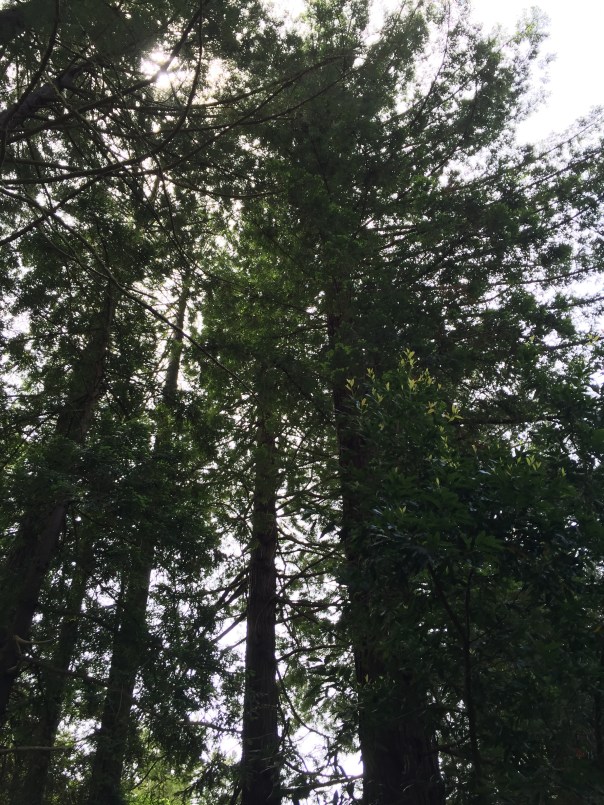
The trees in this picture may be burned now. I saw them in May on an epic drive down Rt. 1 from Carmel to Cambria, California. They are in the Julia Pfeiffer Burns State Park. We were visiting family there. California became home to my daughter some years ago. She was born there, but didn’t return until her early 20’s. She’s forty now, and I’ve been visiting the state regularly, a few times a year. We loved California when we lived there, and we love it still.  California has suffered drought now, for over five years, and this year’s summer fires testify to a tinderbox landscape.  The last time I drove up Rt. 101 to the airport, in spring, firefighters and trucks were busy along the edges of the road, putting out small blazes that started between the highway and the farm fields; sparks become flames quickly in such a landscape. My daughter spent some time in Israel several years ago, and came home convinced that the next big economic, political and social struggles would be about water rights. She has certainly experienced that in California, in her town, and around the state, as access to water has become critical, and hotly debated. During the recent fires, she called to tell me things were getting “apocalyptic.”Now toward the end of September, news of forest fires, floods, vast storms, violent shootings, home-made bombs in cities, military bombings, racism and bigotry, vitriolic presidential politics, divisive and abusive public rhetoric, here and around the world, appear almost non-stop on radio and television stations, in papers, magazines, and social media, permeating everyday conversation, and I agree, it’s feeling apocalyptic.

When we drove through Big Sur, fogs rolled up the cliffs, and drifted in and through the trees. The sun was shining up above, and the light filtered through the woods, shimmering on drifting wisps of cloud, the whole atmosphere cool, and slightly damp, despite the drought. It’s no surprise that cathedral pillars resemble trees–and vaulted ceilings resemble vaulted forests. We remember them in our bones; groves of trees are holy places. In the woods that day, there was still water running in one of the brooks, the sound gurgling down through rocks. When we entered the redwood forest there, all the sounds except for birds and the nearby stream, grew quieter. We grew quieter, the further in we walked. The forest had been burned before, some years ago, and we noticed right away some of the charred markings from long ago fires. We sat for some hours under the trees, marveling at their height, and their ancient impassive presence. But most of all we marveled at their resilience.  Earlier this month, as I read and listened to the news of those fires through the forest in Big Sur, I wondered about the trees which had sheltered us that day. I sometimes feel their roots in me, in my body, that some part of me is as old and present as they were.  I reach out to them through my body and mind, looking for them,  wanting to shelter them in return. Consider the lilies, Jesus said.That phrase has become a symbol for the contemplation of all things living, for all creation. Consider the redwoods, the trickling water, consider the Pacific waves, and the mountains falling into the sea. Consider, even the fires that burn the forests, the interconnections of all our lives and the sorrows of the world. Consider the earth crying out, consider the voices of birds, the haunting call of a loon in the North Woods, consider the whispers and echos of now extinct species.

I checked on the fires yesterday, those still burning,  new ones starting. May the rains come soon.


Trees of Life-Easter VI

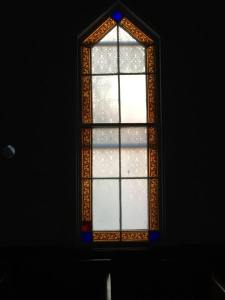
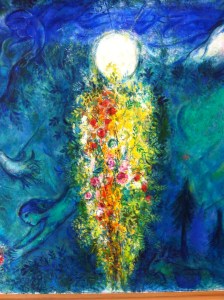
A few days ago, the sun set at about the same time we were holding a small service in the nave of the church. As the sun went down, the light came in the very small openings in our minimalist stained glass windows. By minimalist, I mean that the only stained glass are small squares of beautifully colored glass surrounding the main panes of the frosted windows. The only direct sunlight that enters the sanctuary comes through in fine shafts of colored light, but the whole of the space is illuminated softly, and glows during the sunrises, and sunsets. I was captivated by the sun through the panes, and I took some pictures. Afterwards, as I looked at them, they felt familiar. I knew the source of the familiarity–it had to do with Chagall, and his astonishing colors, biblical imagery, and stained glass. But I didn’t remember precisely what was familiar until today–the shape of the light from the sunset mirrors the image of one of Chagall’s images of the Tree of Life in the Garden of Eden. I have always loved that particular Tree of Life, but had never seen it in person until two years ago. This week, this sixth Sunday of Easter, we’ll read of the Tree of Life in the city of God. No wonder these images have been rising to the surface–I love the way biblical imagery pervades the collective unconscious, and rises when needed, unexpectedly, but there. The Tree of Life rises in the mind of a creative genius of an artist like Chagall; its shape born of something heard and remembered, an echo of an echo, the daughter of a voice. Those images made of biblical words sound down the ear, and become a catechesis of the heart, carving the imagination. An echo becomes a shape in a space so far from here or there, past and future, time and distance undone. One sunset in a week of Easter, seen through one tiny pane of clear glass, becomes the Tree of Life, and the universe opens in all its beauty.

“The leaves of the tree are for the healing of the nations.”

sunset 2 April 27 2016sunset window April 27 2016

sunset one April 27 2016Tree of Life Chagall

Lent II Sunday: Of Icons and Holy Hens

holyhen

Tomorrow, I leave for a 5-day painting retreat at Camp Calumet, in Freedom, New Hampshire. All evening, I’ve been packing up paints, brushes, boards, boots, mittens, warm coats, books and poetry, bits of cotton, random pieces of string I might need, masking tape, pencil sharpeners. The car is becoming a mobile studio and library. This trip has become an annual Lent pilgrimage, the drive north to the mountains through snow now a part of the expectation in this season.  This night before the retreat is one of the evenings of the year when I permit myself the luxury of perusing books of poetry, without feeling like I need to be doing anything else. It’s as if the retreat has already begun. Who will come along? Which poet this year? I find Gary Snyder’s This Present Moment; the cover depicts a snowy landscape, and just because of this, it goes in the bag–Tom Killion is the artist who designed the cover, a long-time friend and collaborator of Snyder’s. I’m quietly thrilled I will have several days to savor these poems. Sometimes a poet’s voice becomes the voice that interprets one’s life–I’ve been reading Snyder for 40 years, and he’s as present in my mind’s ear as the present moment itself.  He’s been a meditation teacher for me, just in the way of his writing.

But by tomorrow afternoon, painting will become the order of the day, this week. We will be working on an icon of St. Francis. It seems appropriate given this morning’s Gospel, to be preparing and praying about Francis this Lent, his conversations with birds and beasts, trees, water, sun, moon and stars.  I love the image of Jesus hovering over Jerusalem like a mother hen, or mother bird, calling his brood to him, gathering them under his wings (or in this case of mixed imagery, Jesus as a “her” gathering the chicks under her wings).  Francis shared that yearning. Tonight, there is a pause in the evening’s packing, a time for gathering all the parts of oneself, as a hen might gather her chicks, up into an inner shelter, a breathing in of anticipated peace, the quiet room, the laundry finishing up, everyone else already asleep.  Lent is just such a pause in a long life really, at least tonight has that feel–the pause of Holy Saturday, though it is weeks away, the pause of a mother bird, as she settles on her nest, the pause between breaths, the pause between death and life.

Diversifying the ELCA: An Alternative Proposal

A forward-looking, encouraging blog from Bishop Michael Rinehart of the ELCA, on possibilities for meta-ecumenical local partnerships in ministry. Worth a read.

Gulf Coast Synod's avatarConnections

By Bishop Michael Rinehart

Church service

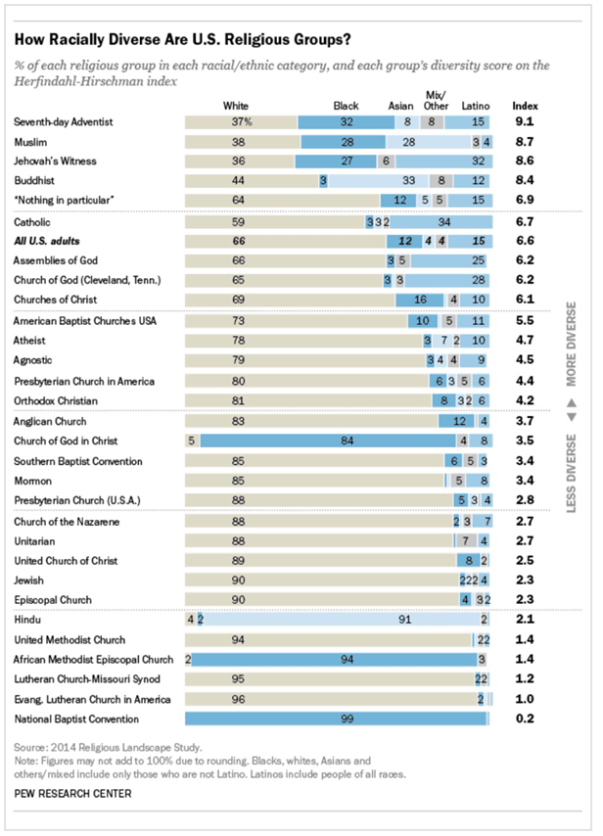
Our goal was to be 10% persons of color in the Evangelical Lutheran Church in America (ELCA) by 1998. In 2016, we are still 96% white. In this synod we are 92% white – better but not good for a synod which includes Houston, which is 50% Latino, and New Orleans, which is 50% African American.

racially diverse religious groups

In our neck of the woods, the Anglo population is actually in decline. The Latino population is swelling, as well as the Asian population. Under the age of 25, 70% of Houston is Latino. Do the math. Just from the vantage point of enlightened self-interest, the Lutheran Church must look at this. There are, however, much more important reasons.

Asians, African Americans, Latinos, Anglos et al have a different angle of vision, based on their life circumstances and location in society. Those more likely to be living in poverty, less…

View original post 1,449 more words

Epiphany 1 day out

follycoveinkspots

This afternoon, I had an unexpected pause in the day, around 3:00 p.m. I was able to stop for awhile, and park near a famous cove on Cape Ann, Folly Cove.  The name came from a failed experiment of harvesting salt, or so I hear.  I thought it was named for the the “folly” structure overlooking the Cove from one of the ledges nearby, an octagonal building, in gazebo style, or perhaps a Japanese style–hard to tell at a distance, looking across the water.

It’s a quiet afternoon; very little traffic on the road next to the Cove. A few parents drive by, to wait up the street at the bus stop for their children. I think someone recognizes my car, and honks.  After several minutes, I lose awareness of the time, though the waves of the water keep pace with heartbeats.  A small flock of buffleheads, black and white males, brown females, bob in and out of the shallows; the tide is mostly out. Ice travels down the crevices of the granite ledge, and the sun shines in low on the north side.  It’s just cold enough to feel like winter, though warm enough to keep the car window open, and even to get out and wander on the rocks, take a few pictures of the afternoon. More and more I wonder what it would be like just to paint them, as so many others do, here in the warmer months. Now and again, a hardier painter sets up near the water, but usually painters paint at other times of the year.  It’s so quiet.

We are just passing into the third phase of Christmastide–Epiphany was yesterday; the Baptism of Jesus is celebrated on Sunday, and then followed by a few weeks of so-called Ordinary Time.  We’ll take down the greens, and the stars, though the memory will be strong. January weather will chill us, but so far this winter, we haven’t had any big snows. Everyone in the neighborhood is grateful for that.  I am so grateful for pauses in the day, especially after stressful mornings and afternoons, like today’s.  I’ve already driven over a hundred miles today, back and forth, here and there, my car, my monastery in motion, silence in between conversations; too many phone calls, too many emails go out, from my side, and are mostly unanswered.  I took a survey recently on pastoral work and technology. “Does technology help you feel more connected to your community?” the surveyors asked. No, not at all, I answered. It’s more distancing.  Unlike rock and water, flesh and bone.  What makes me feel closer are moments like these, when I know the sight, sound, smell, of the ocean will catch anyone who goes by, and more likely than not, we’ll remember and pause in the day, in reverent awe, even if it’s only a few seconds, of the immensity of sky and sea, the solitude of rocks, the friendliness of buffle-heads bobbing on the depths of mysteries too great to fathom.  The baby was born, the light shines, the afternoon passes, the January night draws in, the stars emerge, now, with the promise that God so loves  the world, he shoulders our humanity in himself, and from the cradle reaches toward those who will hold him near.

Passed the Solstice

When I began to write this, it was the first morning of the first day of winter, and with it the return of the light. Dawn was heavy here, deep gray clouds over a deep gray sea. But it’s two days until Christmas, now, rainy, foggy, wet, and the dark is long. Despite the heavy gray, with the shift into winter, I know that light will come back soon. I reread several times, the words to a Christmas carol: “Lo, how a rose.” In all the frenzied rhetoric of politics, and the inflated hysteria of news coverage, I’m so glad to be reminded of the quietness of Advent, and the waiting, the image of a rose not yet bloomed.

Tuesday was the shortest day–the fewest hours of actual sunlight. Today was not much different, this Wednesday before Christmas. The North Pole is tilted away from the sun, tipped earth, ready to turn back, like that far pose of a dancer who leans into space until we think she might fall, and then, as gracefully returns again. The earth rounds her courses along the horizon, the changing line of the sun’s rising mark the course. “O Dawn,” rings in one of the O Anthiphons. And here, for encouragement, from the Rule of Taize: “Renouncing henceforth all thoughts of looking back, and joyful with infinite gratitude, never fear to precede the dawn: to praise and bless and sing Christ your Lord.”

Never fear to precede the dawn with praise. Tonight is a waiting night. Everything is almost ready, a few last details. Each moment I’m grateful for the peace with which I live these days, and carry inside me, too, the sorrows of people, of friends, of family members, of parishioners, of strangers wandering far from home, of what seems like an endless cycle of violence, and into all that a child is born. We had a real baby this year for the Christmas pageant at church, and all he wanted to do was hold onto one of the children’s hands. You could see his tiny fingers grasping hers, curled around, and holding on for dear life. She held onto him, and he held her, an image of Christmas, holding God holding us.

9 Days ’til Christmas

There’s so much I haven’t done. So many ways I’m not ready, never ready for Christmas. This year, in particular, the violence in the world has made the promise of the Prince of Peace so much more significant, the need for peace, for shalom, restoration, wholeness, all these things I long for, as if they could be knitted up in my body, as if the rent cloth could be resown. I know I’m not alone in this longing for the world to be healed. Advent is full of so much longing. Last week, we read Zephaniah during the worship service, and I have come back to these lines so many times:
“The Lord will rejoice over you with gladness, and will renew you with love.”
There’s an Advent expectancy inside those words, and the so much that isn’t or hasn’t or won’t be done are not so important. In the meantime, while the mystery inside the womb of God continues to be mysterious, we are praying and learning, here at home, to be peacemakers, with every breath, breathing peace, wanting to be healers in every word and action, alive with the hope that God really means what God says, and if God renews us with love, this moment is pregnant with it, ready to be born.

The sun is rising over the ocean in the far south this morning, the long rays reach into the house, opening the day. Tomorrow the O Antiphons start–but I love the one: O Come Thou DaySpring. May it be so.

More on gardens-oddly enough

watercave1

During our visit to New York, which happened just before the violence in Paris, we went from backyard Edens to the Brooklyn Botanic Garden. We walked for several hours in a light drizzle of rain through the Japanese hill and pond garden which, that day, displayed an installation of Isamu Noguchi sculptures. Each sculpture grew out of the landscape, organically arising, and surprising. Often there were benches near a sculpture so that we could sit and contemplate the sculpted landscape and the sculpture of the artist, mingling seamlessly in the damp misty day. A rainy day is beautiful way to wander through this garden, with its designs based on principles like impermanence, and interdependent co-arising, sharp edges that led into water, light into darkness and back again. Even the way the red leaves fell from maple trees emphasized the fleeting beauty. Falling rain marked the complicated lines of bark on trees, running slowly down to puddles and pools. There were few people besides ourselves. We went slowly. Later that day we learned of the terrorist attacks in France. The silver light in the wet garden helped to hold the grief of the day, the shapes of beauty helped to hold the sorrow, rain fell, tears fell, so much beauty and tragedy joined in silent tension.

http://www.bbg.org/visit/event/isamu_noguchi_at_brooklyn_botanic_garden

Hidden Forest

image

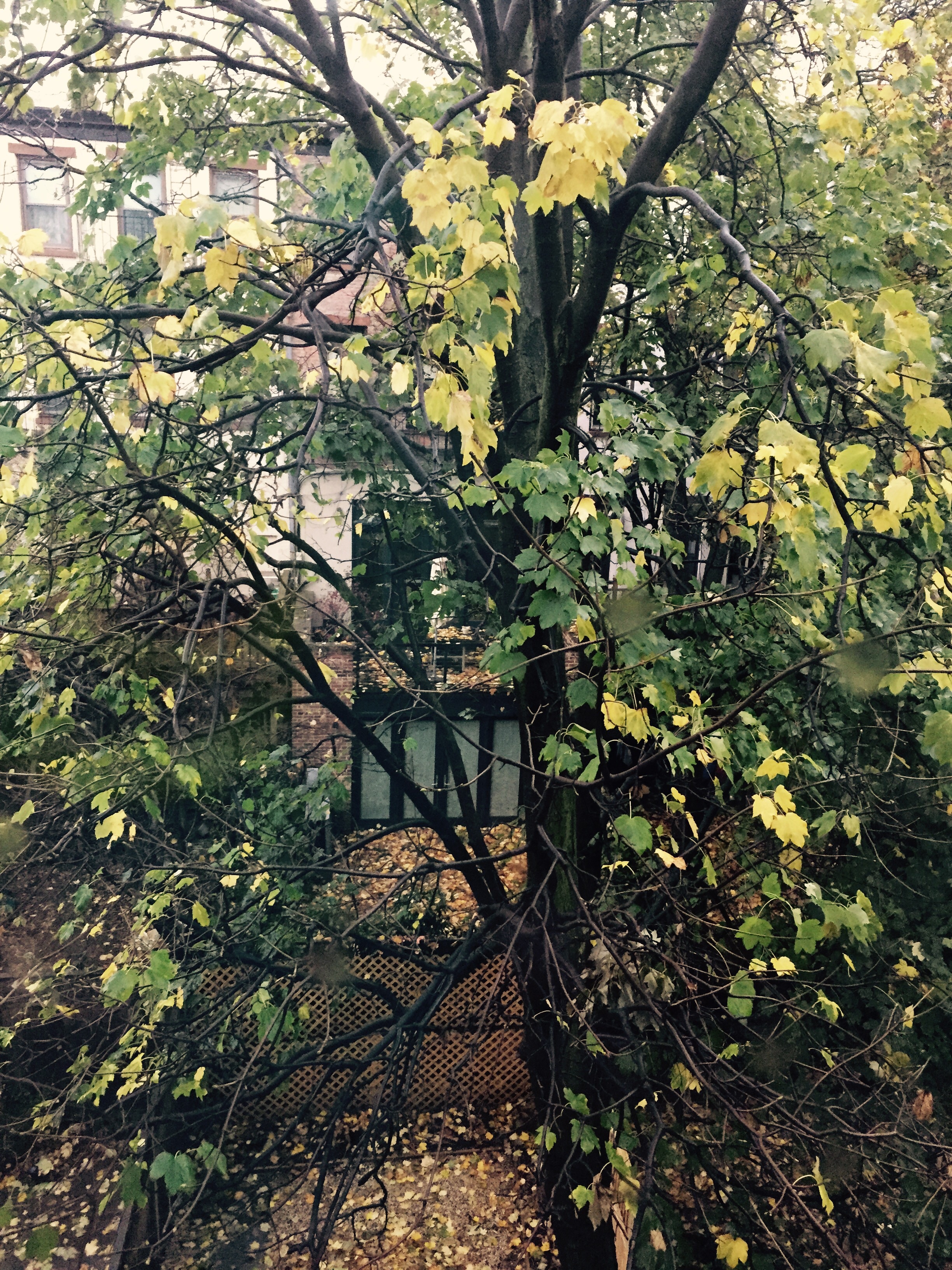
This is a photograph of the courtyard behind the apartment house where we are staying in New York City on a brief trip to visit family. I’m always surprised in NYC at the amount of green that there actually is in a forest of buildings. Last night walking in the dark on the streets, we came across trees whose wide girths testified to their age; someone had imagined they would be needed, those trees, for the future. And they planted them. Yesterday was Martin Luther’s birthday. He may have said something apocalyptic about tree-planting, like this: even if the end of the world were tomorrow, I would plant a tree today. We don’t actually know whether he said it, but he might have. In any case, someone who made this complex of buildings remembered to include courtyards, atriums, inner sanctuaries of surprising green, varieties of foliage, and the humans living here have also added potted vegetables and flowers to their small squares of patio or fire escapes. The effect is comforting and inviting. A sabbath place, or a refreshing place. There are some children’s toys, too, so it’s a playful place.

I love that we remember Eden: somewhere recorded in our primal DNA, we remember the greening place of our origin, a place of peace, a savannah of wide grasslands and sheltering trees with streams of clear water, a garden of life. A real memory traced into our bodies, deep within our bodies, of the first landscapes where humans arose, mythic and otherwise,   where four rivers mark the center of the world, where we all came from between the great rifts of time and space. The memory is still there.  The person who designed the open air atrium, here, remembered those wide green places of Eden, when he or she planted it. Now, this small square is a hidden forest, unseen from the streets, but growing strongly here inside, a sheltering dreaming place, green with life, and today with rain, some mud. Eden will out, given half a chance.

Time Changes

japanese maple marblehead

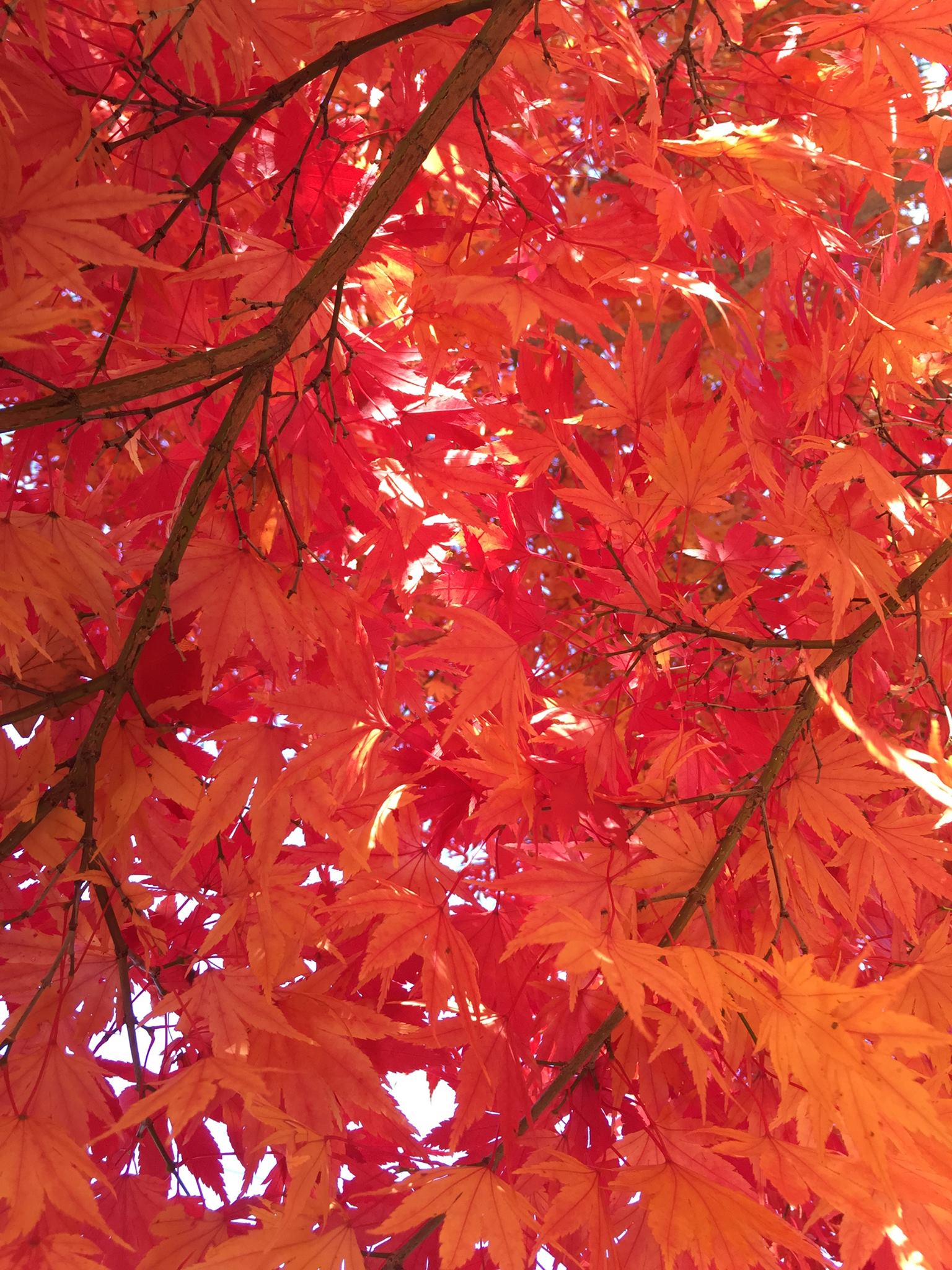
On Sunday morning, in church, we prayed for people in transitions.  The person who offered it prayed for people going through job transitions, or who were moving, or entering a new marriage, or having a baby, or people who have had a change in health, or have lost a loved one.  It was a prayer that reminded us that any change, even a change we initiate, and look forward to, like the birth of a child, or a new relationship or a new job, brings some turbulence with it. A prayer for transitions seemed like a wonderful prayer, too, for a transition of the season. We’re more than mid-way through autumn, and on the far end of fall foliage; there’s less leaves on trees now, and more on the ground to rake. Today because of the end of daylight savings time, the sun rises earlier by the clock, and sets earlier, and like other animals, I’m feeling the transition, too, moving inwardly towards hibernation, and stillness. In our church, we just passed through the three-day observance of All Saints, possibly one of my favorite feast days in the Christian calendar. In Celtic spirituality, it honors the thin places and thin times, where, as they say, the veil between worlds is very thin, and the passage between them is easier. The Feast honors Christian community and its transitions through time, like birth and death, baptism and burial, the sense of generations rising, dying, rising, walking together through the ages, the extraordinary ordinary saints, perfectly imperfect, graced and in need of grace.  It honors, too, the sense of eternal in the every day; despite disconcerting practices like setting clocks backward or forward, there’s a stability in time, though time is always changing. In church, which has its own strange notions of time, we sometimes sing at All Saints a hymn based on St. Patrick’s Breastplate. While the whole hymn is incantatory and invigorating, one verse in particular speaks to me of the eternal within time, impermanence permeated with ultimate reality:
“I bind unto myself today
the virtues of the starlit heaven,
the glorious sun’s life giving ray,
the whiteness of the moon at even,
the flashing of the lightning free,
the whirling wind’s tempestuous shocks,
the stable earth,
the deep salt sea,
around the old eternal rocks.”

One of the original renditions of this hymn can be found here: http://www.ancienttexts.org/library/celtic/ctexts/p03.html

I bind unto myself today, the beauty of this gentle dawn, the fire of the turning trees, and the quiet of the leaf-fall.