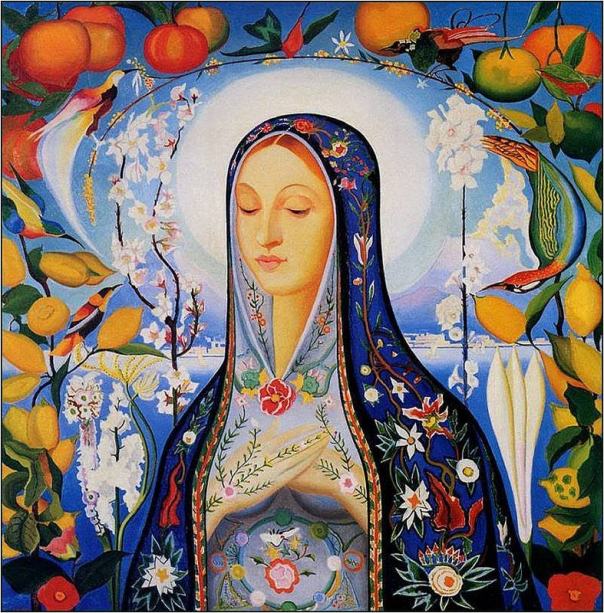
Last year in March, we traveled to the Brooklyn Museum in search of this painting. It is called The Virgin, by Joseph Stella, (American, born in Italy, 1877-1946), and it was part of the museum’s exhibition on “Infinite Blue.” Briefly,
“The works of art in Infinite Blue feature blue in all its variety—a fascinating strand of visual poetry running from ancient times to the present day. In cultures dating back thousands of years, blue—the color of the skies—has often been associated with the spiritual but also signifies power, status, and beauty. The spiritual and material aspects of blue combine to tell us stories about global history, cultural values, technological innovation, and international commerce.” From the Museum website.
I went to Infinite Blue because wanted to see this depiction of Mary, one of the most captivating images of her I have ever seen. I first came across it a few years ago when I was searching for icons related to Hildegard of Bingen, and like Elizabeth in the Gospel of John, my heart leapt when I encountered her. I’m guessing that this particular Mary appeared in the gallery of images because of the abundance of growing things, surrounding, entwining, embracing her, the figures of flowers and vines embroidered on her clothing, the circle of blossoms where Jesus will be…Hildegard’s “viriditas” “greening” is everywhere in this painting. I haven’t looked at the history of this work, so I have no idea if Joseph Stella intended the “viriditas” connection. But what this icon has done is change my experience of Mary. She is always a source of life, carrying the divine within her. She is a garden, here, of earthly and heavenly delights, of beauty and wilderness, of fecundity and blossoming. This is imagery I usually associate with the incarnation and the Tree of Life. There’s no reason Mary shouldn’t be a part of that. I had just not seen it in quite this way. Here, Mary herself becomes a tree of life, which I suppose every woman is: not a Mother Earth, which is always the temptation with Mary, or a representation of the goddess, but a woman who bears and brings and carries life. Stella depicts her as serene, peaceful, but also, I think as holy possibility, that moment after or before or in the midst of her “yes.” This Mary is born of the beauty of earth, and the divine manifests in and through the beauty of earth, the necessity of the material. Like all icons, Stella’s Virgin is a window into a perception of the holy, here entwined in, and arising from, the lavish blessing of creation. I wish I could thank Joseph Stella in person. But perhaps he knows already.
 The Plum Tree
You must be logged in to post a comment.