Tag Archives: ways of seeing

Mary and Viriditas

IMG_7596

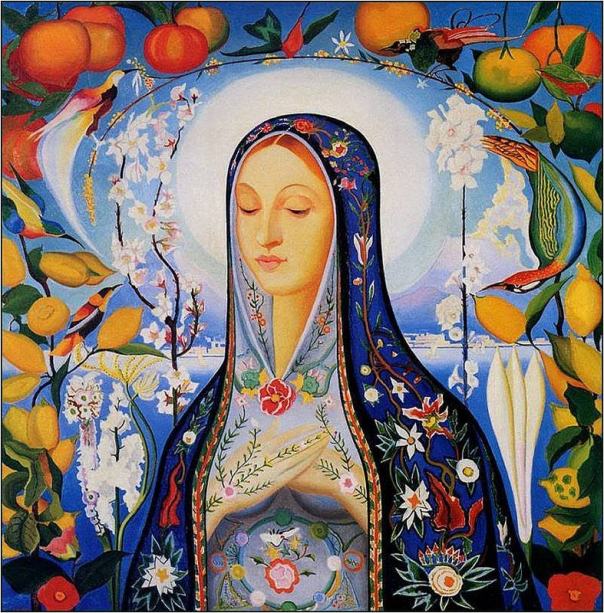
Last year in March, we traveled to the Brooklyn Museum in search of this painting. It is called The Virgin, by Joseph Stella, (American, born in Italy, 1877-1946), and it was part of the museum’s exhibition on “Infinite Blue.” Briefly,

“The works of art in Infinite Blue feature blue in all its variety—a fascinating strand of visual poetry running from ancient times to the present day. In cultures dating back thousands of years, blue—the color of the skies—has often been associated with the spiritual but also signifies power, status, and beauty. The spiritual and material aspects of blue combine to tell us stories about global history, cultural values, technological innovation, and international commerce.” From the Museum website.

I went to Infinite Blue because wanted to see this depiction of Mary, one of the most captivating images of her I have ever seen. I first came across it a few years ago when I was searching for icons related to Hildegard of Bingen, and like Elizabeth in the Gospel of John, my heart leapt when I encountered her. I’m guessing that this particular Mary appeared in the gallery of images because of the abundance of growing things, surrounding, entwining, embracing her, the figures of flowers and vines embroidered on her clothing, the circle of blossoms where Jesus will be…Hildegard’s “viriditas” “greening” is everywhere in this painting. I haven’t looked at the history of this work, so I have no idea if Joseph Stella intended the “viriditas” connection. But what this icon has done is change my experience of Mary. She is always a source of life, carrying the divine within her. She is a garden, here, of earthly and heavenly delights, of beauty and wilderness, of fecundity and blossoming. This is imagery I usually associate with the incarnation and the Tree of Life. There’s no reason Mary shouldn’t be a part of that. I had just not seen it in quite this way. Here, Mary herself becomes a tree of life, which I suppose every woman is: not a Mother Earth, which is always the temptation with Mary, or a representation of the goddess, but a woman who bears and brings and carries life. Stella depicts her as serene, peaceful, but also, I think as holy possibility, that moment after or before or in the midst of her “yes.”  This Mary is born of the beauty of earth, and the divine manifests in and through the beauty of earth, the necessity of the material. Like all icons, Stella’s Virgin is a window into a perception of the holy, here entwined in, and arising from, the lavish blessing of creation.  I wish I could thank Joseph Stella in person. But perhaps he knows already.
Returned from the Pilgrimage

chatauqua geese

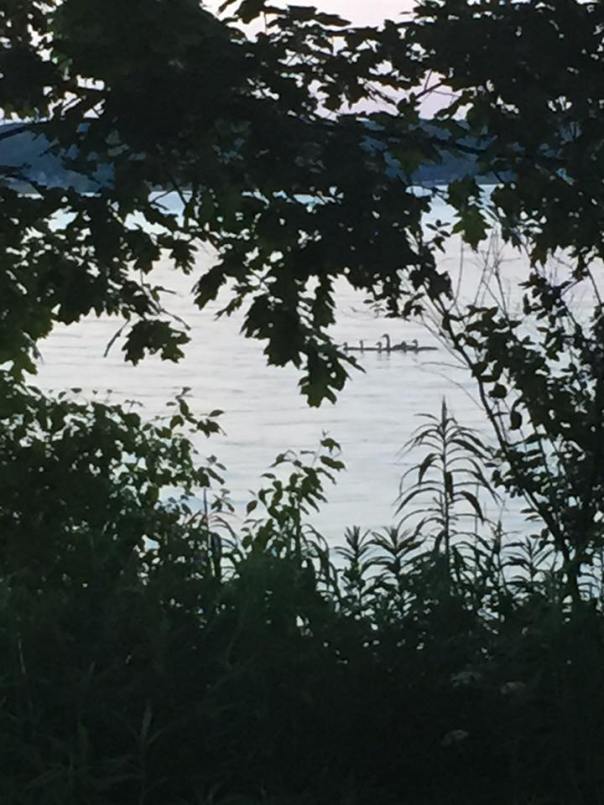
The image above was taken this summer on our last leg of a sabbatical journey. I gave  the sabbatical a name: “Beloved Community: A Pilgrimage.” The lake is Lake Chautauqua, the Chautauqua Institution being one of the communities we visited during what was a 9500 mile pilgrimage around our country. I have only begun to put the experience into words. Recently, I gave an hour-long presentation at St. Paul Lutheran Church, where I serve, to try and report on what I discovered along the way. For this short entry, first, all the beloved communities we visited had a commitment to non-violence. Second, all that they did together was aimed toward healing, healing the world, their neighbors, the people living within their communities. Third, the visionary expectation of these communities was very simple–every loving act or word we offer the world in our daily life and work, wherever and whoever we are, those acts of love in speech and action, bear the fruit of peace. During the trip, I thought often of Jesus’ beatitude: “blessed are the peacemakers.”

Often in the evenings wherever we were, we took time to sit and review our days, recollecting in the prayerful sense of the word what we’d seen and experienced, talking softly, as we watched the sunset. Here, on the shore of Chautauqua, we were nearing the end of our journey. As we sat in the quiet, a family of geese swam slowly around the shore in the evening light. The geese stayed close together, goslings following their parents’ stately lead, defenseless on a shining lake. They knew they were safe there, from human beings, for the time being, so they didn’t flee when they saw us. I had been thinking about what is necessary for beloved community to arise. One thing is simple: one has to feel safe. And if safety isn’t present, the community needs to work toward it. Beloved community is built on trust.

Mid-October 2016

red-leaves

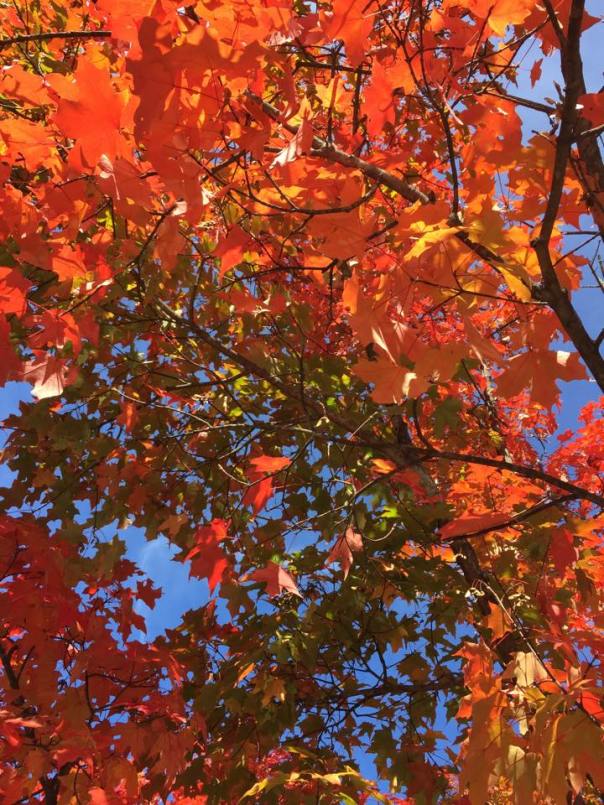
Yesterday’s walk down the sidewalk proved to be an exercise in wonder. Everywhere we looked, our eyes feasted, on the burning beauty of autumn overflowing, the air as clear as clear water; sky and sea blue beyond blue. At the farmer’s market, the bins were cornucopias of the harvest, greens, oranges, reds of squash, beets, onions, potatoes, the last tomatoes, fresh apples.

And all the while, in my mind’s eye, next to this beauty, are juxtaposed images of devastation, from Syria, from Haiti, from North Carolina, the wake of storms, floods, and bombs. Like most people, I’ve been torn apart inside by what’s happening in our country especially during this presidential election season, by the ugliness, the degradation, by the violence, the on-going intersection of injustices of racism, sexism, poverty. On the one hand, all the hatred is out in the open;  we can see it. On the other hand, I’m terrified because the hatred is out in the open, and it seems like there’s a license to kill figuratively and literally, with guns and with words. It’s a raw time. My spiritual struggle is how to speak, and to act, with love, in such times, when the temptation every day is to sink into fear, anger and despair

And then I remember the stories of incredible faith, hope, and courage coming from Aleppo, from Haiti, from children, from the songs of whales, from the breath of the earth, and the Spirit’s sighs too deep for words.

This morning, I read a wonderful column/blog post by a fellow clergy-woman at https://revgalblogpals.org/ I’m sharing it below, because it’s a wonderful affirmation that words matter. And that we rise for another day, to speak words that create worlds–to borrow Abraham Joshua Heschel’s phrase. May our words make worlds of compassion.

Words Matter.

Big Sur in May

image

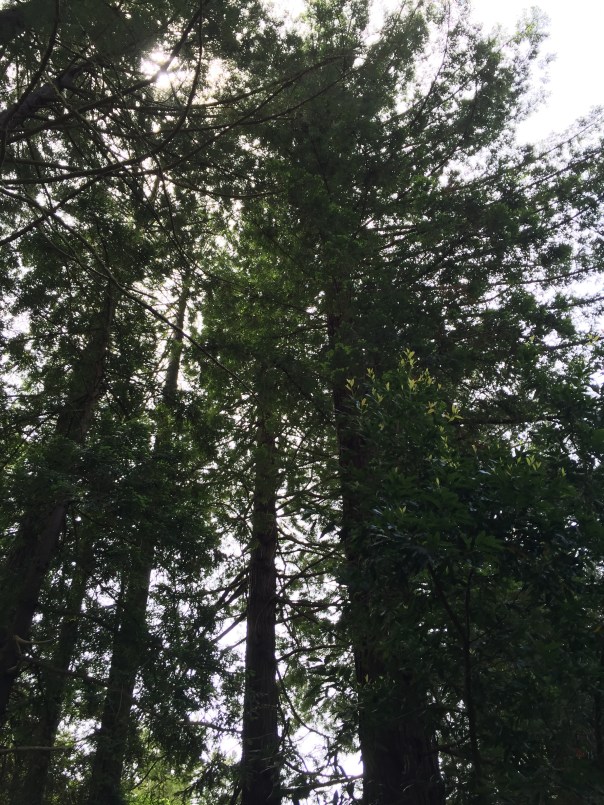
The trees in this picture may be burned now. I saw them in May on an epic drive down Rt. 1 from Carmel to Cambria, California. They are in the Julia Pfeiffer Burns State Park. We were visiting family there. California became home to my daughter some years ago. She was born there, but didn’t return until her early 20’s. She’s forty now, and I’ve been visiting the state regularly, a few times a year. We loved California when we lived there, and we love it still.  California has suffered drought now, for over five years, and this year’s summer fires testify to a tinderbox landscape.  The last time I drove up Rt. 101 to the airport, in spring, firefighters and trucks were busy along the edges of the road, putting out small blazes that started between the highway and the farm fields; sparks become flames quickly in such a landscape. My daughter spent some time in Israel several years ago, and came home convinced that the next big economic, political and social struggles would be about water rights. She has certainly experienced that in California, in her town, and around the state, as access to water has become critical, and hotly debated. During the recent fires, she called to tell me things were getting “apocalyptic.”Now toward the end of September, news of forest fires, floods, vast storms, violent shootings, home-made bombs in cities, military bombings, racism and bigotry, vitriolic presidential politics, divisive and abusive public rhetoric, here and around the world, appear almost non-stop on radio and television stations, in papers, magazines, and social media, permeating everyday conversation, and I agree, it’s feeling apocalyptic.

When we drove through Big Sur, fogs rolled up the cliffs, and drifted in and through the trees. The sun was shining up above, and the light filtered through the woods, shimmering on drifting wisps of cloud, the whole atmosphere cool, and slightly damp, despite the drought. It’s no surprise that cathedral pillars resemble trees–and vaulted ceilings resemble vaulted forests. We remember them in our bones; groves of trees are holy places. In the woods that day, there was still water running in one of the brooks, the sound gurgling down through rocks. When we entered the redwood forest there, all the sounds except for birds and the nearby stream, grew quieter. We grew quieter, the further in we walked. The forest had been burned before, some years ago, and we noticed right away some of the charred markings from long ago fires. We sat for some hours under the trees, marveling at their height, and their ancient impassive presence. But most of all we marveled at their resilience.  Earlier this month, as I read and listened to the news of those fires through the forest in Big Sur, I wondered about the trees which had sheltered us that day. I sometimes feel their roots in me, in my body, that some part of me is as old and present as they were.  I reach out to them through my body and mind, looking for them,  wanting to shelter them in return. Consider the lilies, Jesus said.That phrase has become a symbol for the contemplation of all things living, for all creation. Consider the redwoods, the trickling water, consider the Pacific waves, and the mountains falling into the sea. Consider, even the fires that burn the forests, the interconnections of all our lives and the sorrows of the world. Consider the earth crying out, consider the voices of birds, the haunting call of a loon in the North Woods, consider the whispers and echos of now extinct species.

I checked on the fires yesterday, those still burning,  new ones starting. May the rains come soon.


Trees of Life-Easter VI

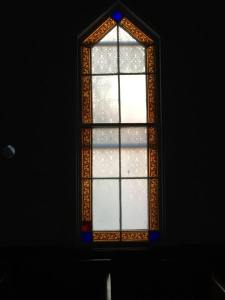
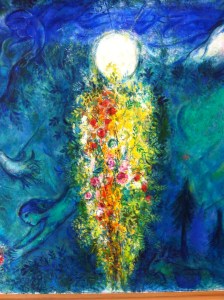
A few days ago, the sun set at about the same time we were holding a small service in the nave of the church. As the sun went down, the light came in the very small openings in our minimalist stained glass windows. By minimalist, I mean that the only stained glass are small squares of beautifully colored glass surrounding the main panes of the frosted windows. The only direct sunlight that enters the sanctuary comes through in fine shafts of colored light, but the whole of the space is illuminated softly, and glows during the sunrises, and sunsets. I was captivated by the sun through the panes, and I took some pictures. Afterwards, as I looked at them, they felt familiar. I knew the source of the familiarity–it had to do with Chagall, and his astonishing colors, biblical imagery, and stained glass. But I didn’t remember precisely what was familiar until today–the shape of the light from the sunset mirrors the image of one of Chagall’s images of the Tree of Life in the Garden of Eden. I have always loved that particular Tree of Life, but had never seen it in person until two years ago. This week, this sixth Sunday of Easter, we’ll read of the Tree of Life in the city of God. No wonder these images have been rising to the surface–I love the way biblical imagery pervades the collective unconscious, and rises when needed, unexpectedly, but there. The Tree of Life rises in the mind of a creative genius of an artist like Chagall; its shape born of something heard and remembered, an echo of an echo, the daughter of a voice. Those images made of biblical words sound down the ear, and become a catechesis of the heart, carving the imagination. An echo becomes a shape in a space so far from here or there, past and future, time and distance undone. One sunset in a week of Easter, seen through one tiny pane of clear glass, becomes the Tree of Life, and the universe opens in all its beauty.

“The leaves of the tree are for the healing of the nations.”

sunset 2 April 27 2016sunset window April 27 2016

sunset one April 27 2016Tree of Life Chagall